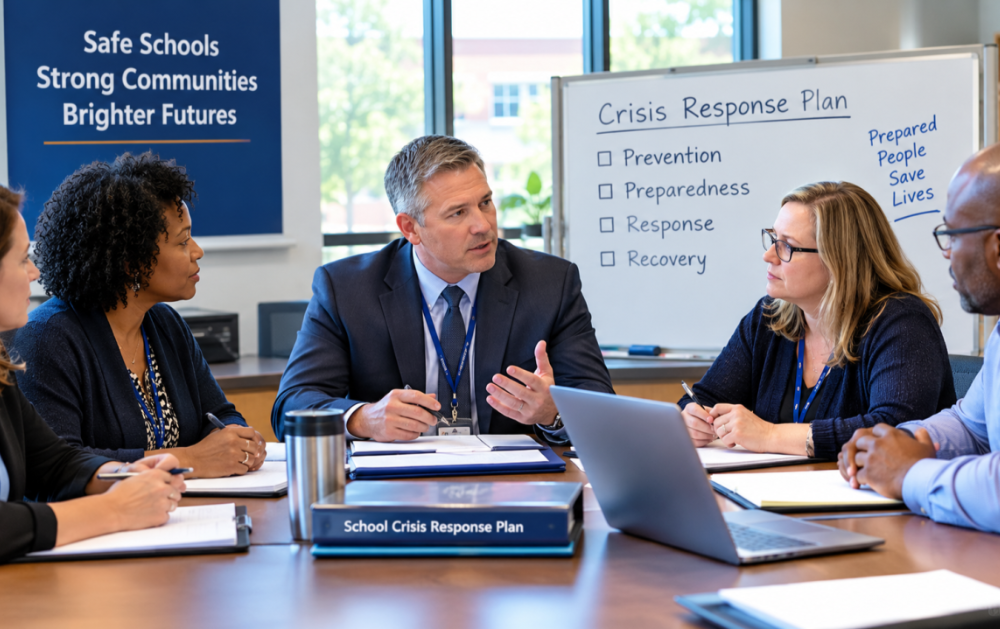
When was the last time your school assessed not just its safety procedures, but leadership's ability to make those procedures work?
School districts invest time, money, and considerable effort in school safety. They develop emergency plans, establish threat assessment teams, conduct training, and implement security measures.
These are important steps.
But having the right components doesn't automatically mean they work together effectively.
Who is responsible for ensuring they do? How does leadership know whether procedures are understood, communication is effective, and identified weaknesses are actually corrected?
These are questions worth asking before a crisis forces the answers.
School safety is more than a collection of plans
Consider a school district with written emergency procedures, a behavioral threat assessment process, and trained personnel.
On paper, the district appears prepared.
But what happens when a teacher reports concerning student behavior? Does the information reach the appropriate people? Are responsibilities clear? Can those involved explain the next steps? And if a weakness is identified, who ensures it is addressed?
Now consider a different problem.
Leadership believes staff understand their responsibilities, but no one has recently tested that assumption. A procedure exists, but its practical application has never been evaluated. A previous exercise identified a gap, but there is no clear evidence that the corrective action was completed.
None of these situations necessarily means a district is unsafe.
They do, however, raise legitimate questions about readiness, accountability, and oversight.
The difference between having a safety program and having an effective one is something leadership needs to assess, not assume.
Prevention begins before an incident becomes a crisis
Workplace violence prevention is often discussed in terms of training, security measures, emergency response, and written policies.
All have a role.
But effective prevention also requires an organization to recognize concerning behavior, evaluate information in context, communicate appropriately, and make informed decisions about what to do next.
In K–12 settings, that responsibility intersects with student safety, staff safety, student support, and the school's broader duty of care.
The same principle applies across other workplaces.
The question isn't simply whether an organization has a plan for responding to violence. It's whether its leadership has the processes, information, and accountability needed to address risk before a situation escalates.
That is why school safety and workplace violence prevention must be considered not only operationally, but also as leadership responsibilities.
Start at the top: Examine the entire organization
A meaningful school safety assessment should begin with leadership.
Not because administrators are responsible for every operational detail, but because leadership establishes priorities, assigns responsibility, allocates resources, and determines how performance is evaluated.
A top-down assessment starts by asking whether those responsibilities are clearly defined and supported.
It then examines how leadership's expectations translate into practice throughout the district and its individual schools.
Five areas deserve particular attention.
1. Leadership and accountability
- Does everyone understand who is responsible for the major components of school safety?
- Are responsibilities clearly defined among district leadership, principals, student services, threat assessment teams, and security personnel?
- Does leadership receive the information it needs to identify concerns and make informed decisions?
A responsibility that exists only on paper may not provide the accountability the organization needs.
2. Policies and procedures
- Are safety policies current, understood, and consistent with applicable requirements?
- Do staff know how to report a concern, and do they understand what happens after they make that report?
- Are behavioral threat assessment, emergency preparedness, and other relevant safety processes coordinated appropriately?
A policy should guide action. Its existence alone does not demonstrate that it works.
3. Behavioral risk recognition and management
- Do staff know how to recognize and report concerning behavior without jumping to conclusions?
- Is there a consistent process for gathering information, considering context, assessing concerns, and determining appropriate interventions?
- Are responsibilities for follow-up clear?
Not every concerning behavior signals a threat. Effective assessment requires looking beyond isolated incidents, avoiding assumptions, and considering the totality of the available information.
The objective is not to label students. It is to support informed decisions that protect the school community while allowing appropriate, proportionate responses.
4. Communication and operational readiness
- Do the people responsible for school safety communicate effectively?
- Can staff explain what they should do when a concern arises or an emergency occurs?
- Have procedures been tested through appropriate exercises, discussions, or realistic scenarios?
A process may appear straightforward in a written plan but become much more complicated when people must apply it under pressure.
Testing helps reveal that difference.
5. Oversight and corrective action
- When an assessment, exercise, or incident reveals a weakness, what happens next?
- Is the issue documented? Is someone assigned responsibility for correcting it? Is there a deadline? Does leadership verify that the corrective action was completed?
Without follow-through, the same weaknesses can persist despite repeated reviews, training sessions, and policy updates.
Identifying a gap is important. Making sure it gets corrected is what turns that finding into progress.
Five questions every school leadership team should ask
You don't need to begin with another lengthy report. Start by asking five straightforward questions:
1. Accountability: Can we clearly identify who is responsible for each major aspect of school safety?
2. Process: Do we know how a concern moves from initial reporting to assessment, decision, and follow-up?
3. Communication: Can we demonstrate that relevant information reaches the people who need it to make informed decisions?
4. Readiness: Have we tested whether our procedures work in practice, rather than simply confirming that they exist?
5. Corrective action: Can we show that identified weaknesses are assigned, addressed, and reviewed?
These questions are a starting point, not a substitute for a comprehensive school safety assessment. They can, however, help leadership identify where a closer examination may be warranted.
The answers should be supported by evidence, not simply confidence or assumptions.
School safety is a leadership responsibility
No school district can eliminate every risk. No assessment can guarantee that an incident will never occur.
But school leaders can take steps to understand their vulnerabilities, clarify responsibilities, improve decision-making, and strengthen the processes intended to protect their communities.
That requires looking beyond whether plans exist.
It requires examining how the organization functions, where gaps may exist, and whether leadership has a reliable way to address them.
The goal isn't to create more paperwork or another checklist that gets filed away.
The goal is to improve the organization's ability to recognize concerns, make informed decisions, act appropriately, and learn from what it discovers.
That is how assessment becomes prevention.
One final question for school leaders:
If you were asked today to demonstrate how your school safety program works in practice—not just what your policies say—what evidence would you be able to provide?
It's worth knowing the answer before you need it.
Because when it comes to school safety, confidence is important.
Evidence is better.
Next Step
Bring behavioral threat assessment clarity to your organization.
Risk Mitigation Technologies works with leadership teams to build recognition, reporting, and decision pathways that hold up under scrutiny.