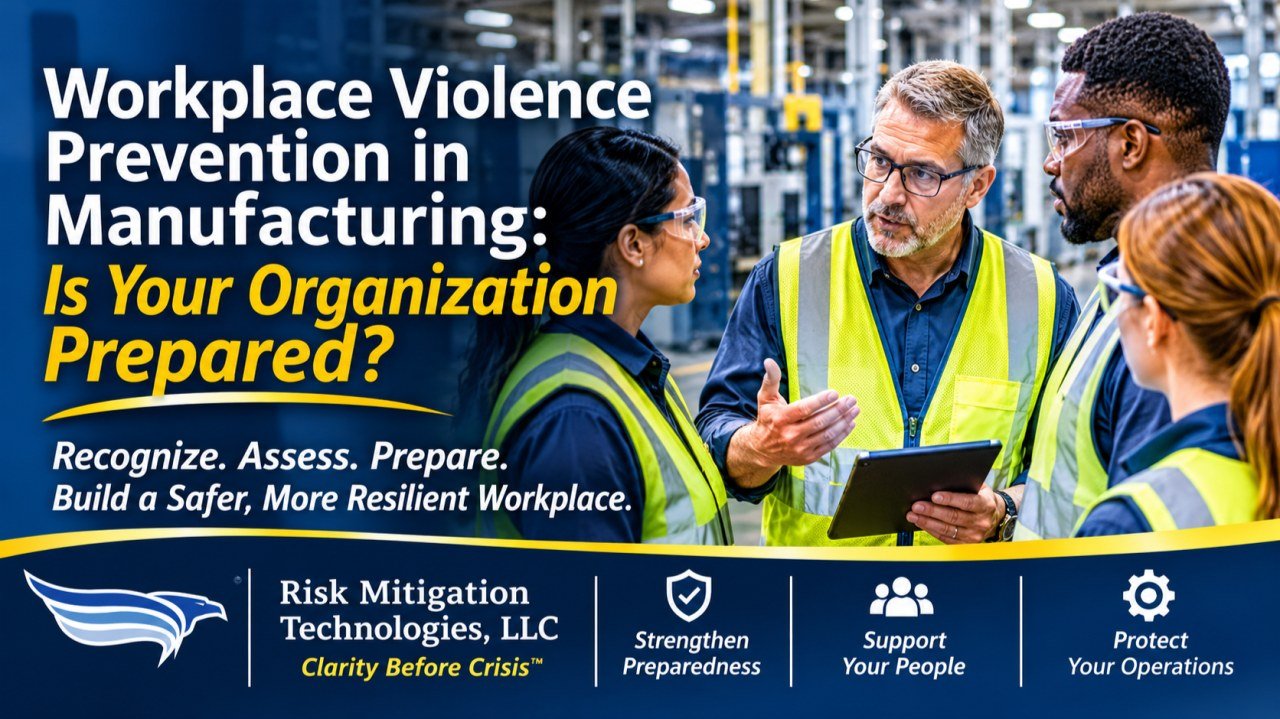
Workplace violence prevention requires more than policies and training. Manufacturing leaders need a clear process for recognizing concerning behavior, evaluating risk, and making defensible decisions before a situation escalates.
Imagine you're responsible for operations at a manufacturing facility.
A supervisor reports repeated confrontations with an employee whose frustration appears to be growing. Human Resources has received a complaint involving a workplace grievance. Another manager has noticed increasingly hostile communications.
No direct threat has been made. No single incident necessarily appears serious enough to demand an emergency response.
But something doesn't seem right.
Each department has a piece of the picture. Who is responsible for connecting the information, assessing the situation, and determining what should happen next?
More importantly, is your organization prepared to make that decision?
For manufacturing leaders, this is an important question. The challenge isn't simply responding to an obvious threat. It's recognizing when a developing situation warrants attention, determining what the available information means, and taking appropriate action before the consequences become more serious. Explore our approach to workplace violence prevention and organizational preparedness.
What Does Effective Workplace Violence Prevention in Manufacturing Require?
Effective workplace violence prevention requires more than written policies and employee training. Organizations need clear reporting procedures, defined responsibilities, appropriate information-sharing practices, and a process for assessing concerning behavior and managing identified risks.
Leaders should periodically evaluate whether these procedures work in practice and whether supervisors and relevant personnel understand their responsibilities.
The objective isn't to predict violence with certainty. It's to recognize concerns early, evaluate information in context, and make informed, proportionate decisions that support workplace safety and organizational preparedness.
Why Workplace Violence Prevention Policies Are Not Enough
Manufacturing organizations understand the importance of operational safety. They establish procedures, train employees, investigate incidents, and work to reduce workplace hazards.
Workplace violence prevention deserves the same deliberate attention.
Yet a written policy, employee handbook, or annual training program does not automatically establish how an organization will manage a developing behavioral concern. For additional guidance, consult OSHA's workplace violence prevention resources.
Consider a few practical questions:
- When a supervisor observes concerning behavior, does the supervisor know whom to notify?
- When HR, operations, and Security have different pieces of relevant information, is there a process for appropriate coordination?
- Who determines whether a concern requires further assessment, additional support, workplace intervention, or other protective measures?
- Who has the authority to make decisions when the available information is incomplete?
If these responsibilities are unclear, an organization may struggle to respond consistently when a situation becomes more complicated.
The problem isn't necessarily a lack of policies. It may be a gap between having procedures on paper and being prepared to apply them under real-world conditions.
Why Workplace Violence Prevention Is a Leadership Responsibility
Workplace violence prevention cannot rest solely with Human Resources or Security.
HR may understand an employee's workplace history. Supervisors may recognize changes in conduct. Operations leaders understand the demands and dynamics of the work environment. Security professionals may contribute expertise in threat assessment, protective measures, and risk management.
Each perspective can be valuable. None necessarily provides the complete picture.
Organizational leaders are responsible for ensuring that appropriate personnel can share relevant information, concerns receive suitable attention, and decision-making responsibilities are clearly established. Our behavioral-risk consulting services help leaders evaluate concerning situations and make informed, defensible decisions.
That doesn't mean every concerning employee interaction should become a security matter. Nor does it mean that frustration, workplace conflict, or a grievance automatically signals a risk of violence.
It means having a consistent, fair, and proportionate process for evaluating concerns in context and determining what response, if any, is warranted.
Effective prevention depends on recognizing the difference between an isolated workplace problem and a pattern of behavior that may require a more structured assessment.
The goal isn't to predict violence with certainty. It's to make better-informed decisions, manage identified risks, and intervene appropriately before a situation deteriorates.
OSHA's Safety and Health Program Management Guidelines provide additional context for management leadership and systematic workplace safety practices.
Five Questions Manufacturing Leaders Should Ask About Workplace Violence Prevention
You don't need to wait for a serious incident to evaluate your organization's preparedness. Start by asking five questions.
1. Do employees and supervisors know how to report concerning behavior?
Reporting procedures should be understandable, accessible, and practical. Employees need to know where to bring a concern, while supervisors need guidance on documenting observations and escalating issues appropriately.
2. Who evaluates a concern when there is no explicit threat?
Not every concerning situation includes a direct threat or policy violation. Leaders should understand how their organization evaluates behavior in context, considers relevant information, and determines whether further assessment is appropriate.
3. How do HR, operations, Security, and leadership coordinate?
Relevant information may be distributed across departments. Organizations need appropriate communication and coordination procedures that respect privacy, confidentiality, employment obligations, and applicable law.
4. Who is responsible for deciding what happens next?
Identifying a concern is only the beginning. Someone must have the authority and responsibility to determine the next steps, identify appropriate interventions, and ensure decisions are communicated and followed through.
5. Has your organization tested its process under realistic conditions?
Policies may appear clear until leaders must apply them to a complicated scenario. Tabletop exercises and crisis simulations can reveal communication gaps, unclear responsibilities, and decision-making challenges before those weaknesses are tested by an actual incident.
These questions are not a substitute for a comprehensive assessment. They are a starting point for determining whether your organization's approach to workplace violence prevention is as effective in practice as it appears on paper.
How Behavioral Threat Assessment and Management Helps Organizations Manage Risk
Effective workplace violence prevention requires more than recognizing warning signs. It requires a process for evaluating information, assessing behavior in context, making decisions, and managing identified concerns over time.
Behavioral threat assessment and management can help organizations structure that process.
Depending on the circumstances, appropriate measures may include additional fact-finding, consultation with qualified professionals, employee support, conflict resolution, workplace adjustments, enhanced protective measures, or coordination with law enforcement when warranted.
The appropriate response depends on the available information, the nature of the concern, and a reasoned assessment of the circumstances. It should not be based on assumptions, stereotypes, or a single behavior viewed in isolation.
Preparation matters, too.
Supervisors need to recognize when a concern warrants escalation. Leaders need to understand their decision-making responsibilities. Teams need opportunities to practice communicating and coordinating when information is incomplete and time matters.
These capabilities help organizations move from reactive responses toward a more deliberate, prevention-focused approach.
How Manufacturing Organizations Can Improve Workplace Violence Preparedness
Manufacturing leaders cannot eliminate every workplace risk. They can, however, strengthen their organization's ability to recognize concerns, evaluate information, and respond appropriately.
A practical starting point is to review existing workplace violence prevention policies, reporting pathways, assessment procedures, decision-making responsibilities, and training.
Leaders should also consider whether their organization has a clear process for coordinating relevant information across departments and whether that process has been tested through realistic scenarios.
An independent review can help identify gaps, clarify responsibilities, and establish priorities for improvement. Learn more about our Workplace Violence Prevention Risk Readiness Assessment to explore how your organization can evaluate its preparedness and identify opportunities for improvement.
The objective is not to create unnecessary bureaucracy or treat every workplace disagreement as a potential threat. It is to establish a proportionate, consistent process that helps the organization respond appropriately when concerns arise.
Is Your Manufacturing Organization Prepared?
A written workplace violence prevention policy is a starting point, not proof that an organization is prepared to manage a developing behavioral concern.
Manufacturing leaders should understand whether employees know how to report concerns, supervisors know when to escalate them, and appropriate personnel can evaluate information and make timely, defensible decisions.
At Risk Mitigation Technologies, LLC, I help organizational leaders assess behavioral risk, evaluate workplace violence prevention practices, identify preparedness gaps, and strengthen decision-making before concerning behavior escalates into serious incidents, operational disruption, or potential legal exposure.
If you're responsible for workplace safety, security, HR, or operations, let's start with a conversation about your organization's preparedness and where practical improvements may be needed.
Clarity Before Crisis™
Better Decisions. Better Preparation. Safer Workplaces.
About the Author
Joseph “Paul” Manley is an independent security advisor and Principal Consultant at Risk Mitigation Technologies, LLC. Drawing on more than 35 years of experience across law enforcement, investigations, crisis management, and security consulting, he helps organizational leaders assess behavioral risk, strengthen workplace violence prevention, and make defensible decisions before concerning behavior escalates.
Next Step
Strengthen workplace violence preparedness in your organization.
Risk Mitigation Technologies works with leadership teams to build recognition, reporting, and decision pathways that hold up under scrutiny.